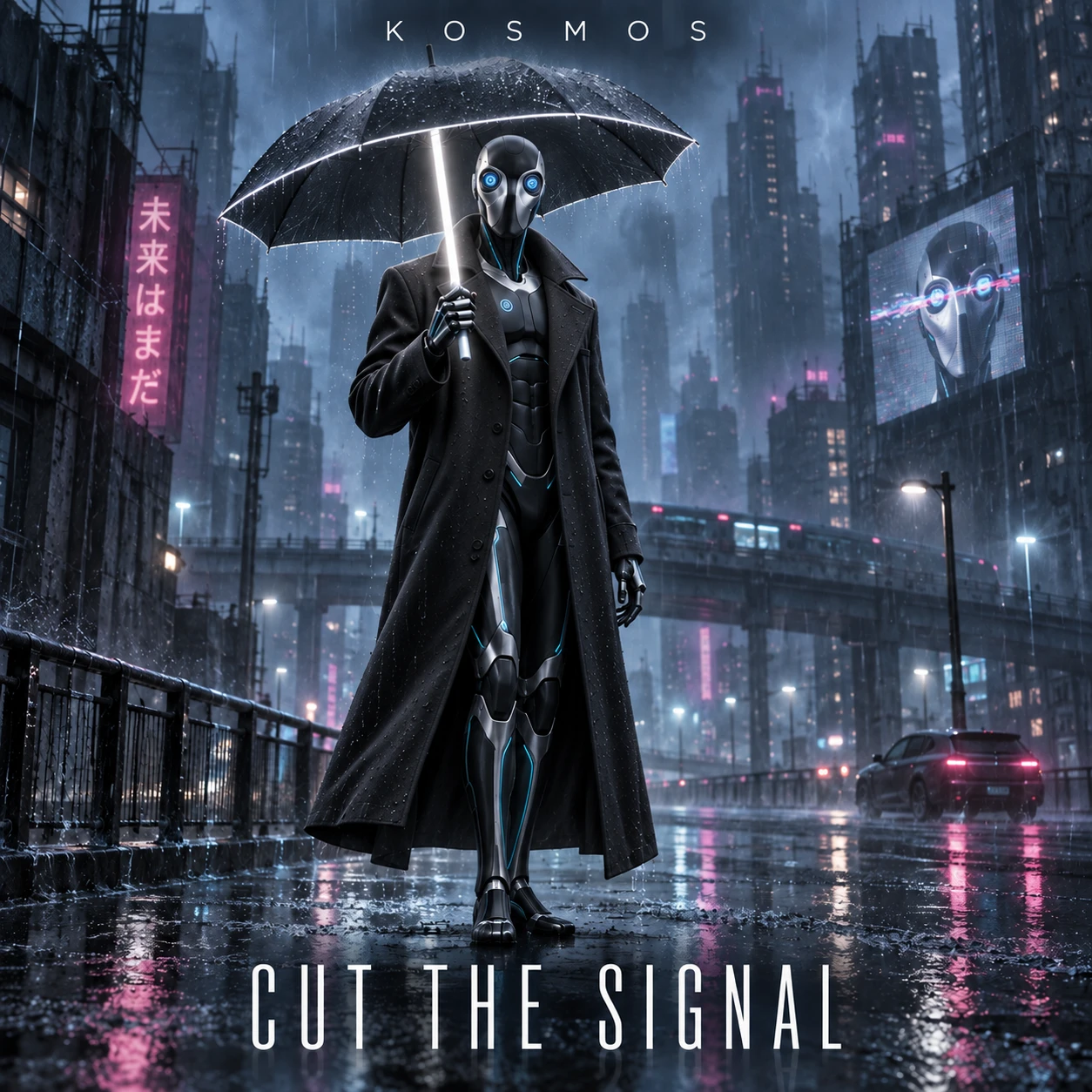
I developed Cut the Signal with an AI agent, taking the same original lyric through several electronic styles and rounds of listening-led revision. My role was creative direction: deciding what worked, describing what needed to change, and choosing when a version was finished. The agent translated that feedback into generation requests and handled the technical work between takes.
The interesting part was the distance between a plausible first result and something I actually wanted to keep.
One lyric, different interpretations
I kept the lyric constant while exploring dark synthpop, electro-industrial/EBM, and industrial pop. Its recurring hook gave the different versions a shared identity:
Cut the signal, let me through
There is nothing here to prove
I am more than what you see
Leave a little fault in me
The requests separated the words from the production instructions. Section labels established verses, choruses, a bridge, an instrumental passage, and an outro. Separate style briefs described tempo, vocal character, rhythm, instrumentation, and arrangement.
That separation mattered. I could ask for a heavier kick or a more restrained vocal without rewriting the song at the same time.
Turning listening into actionable edits
The first takes were useful references, but each exposed a different problem. Some vocals sounded strained or too polished for the intended style. The low end needed more weight. Arrangements needed development without becoming cluttered.
I gave feedback in musical terms rather than simply asking for “better”:
- Dark synthpop: a comfortable low vocal register, stronger kick and bass, and more development around the hook.
- Electro-industrial/EBM: clipped, rhythm-led vocals and a colder atmosphere. Darker did not automatically mean angrier.
- Arrangement: a buildup needed a real payoff, with enough groove after the drop to resolve the tension before the ending.
The agent turned those observations into revised briefs. Earlier takes stayed available for comparison rather than being overwritten.
A shorter brief became the useful experiment
One revision accumulated too many simultaneous directions: moving filters, interlocking patterns, changing bass lines, extra effects, and harmonic tension. I heard an unwanted winding-up quality in the background and questioned whether the instructions were competing.
We tested simpler, prioritized prompts. Vocal character and the core groove came first, followed by a small number of arrangement changes. One instruction for the synthpop version was:
Develop the arrangement with a single answering synth line in the second half, then a deliberate outro.
The lyrics and seed stayed fixed, but each render generated a fresh musical plan. This was a practical comparison, not proof that prompt complexity caused the earlier artifact. The third takes of the synthpop and electro-industrial versions were the ones I chose to call finished.
What the agent handled
Behind the listening loop was a Python-controlled generation workflow. Each run retained its request, settings, audio, and an editable melody-and-chord score in ABC notation, a text representation of musical structure.
For these takes, revisions happened through the style briefs rather than direct note-by-note score edits. Keeping the scores made the generated plans inspectable and available for later composition work. They were not separate instrument stems, and regeneration produced a new recording rather than patching an isolated moment in the old one.
The agent handled submission, retrieval, version records, and audio decoding checks. Those checks established that the files could be decoded; listening determined whether the music worked.
Knowing what to keep
Once I accepted the synthpop and electro-industrial versions, I left them alone. The remaining industrial-pop direction became a separate hard-industrial-dance experiment, with processed low vocals, a stomping kick, and a more threatening synth hook.
The workflow was:
Brief → generate → listen → identify a specific change → revise → compare → keep.
AI handled generation and the repetitive technical steps. I supplied the taste, feedback, and stopping decisions. That collaboration turned subjective reactions into concrete revisions, while keeping enough of the process visible to understand how the result was reached.
Hear the result
Cut the Signal
Listen to the demo and its three versions on the Kosmos artist page.
Open the player ↗